Dates
July 1, 2026 → July 4, 2026
Route
Malcesine
View table of contents
Malcesine, Capital of Foiling
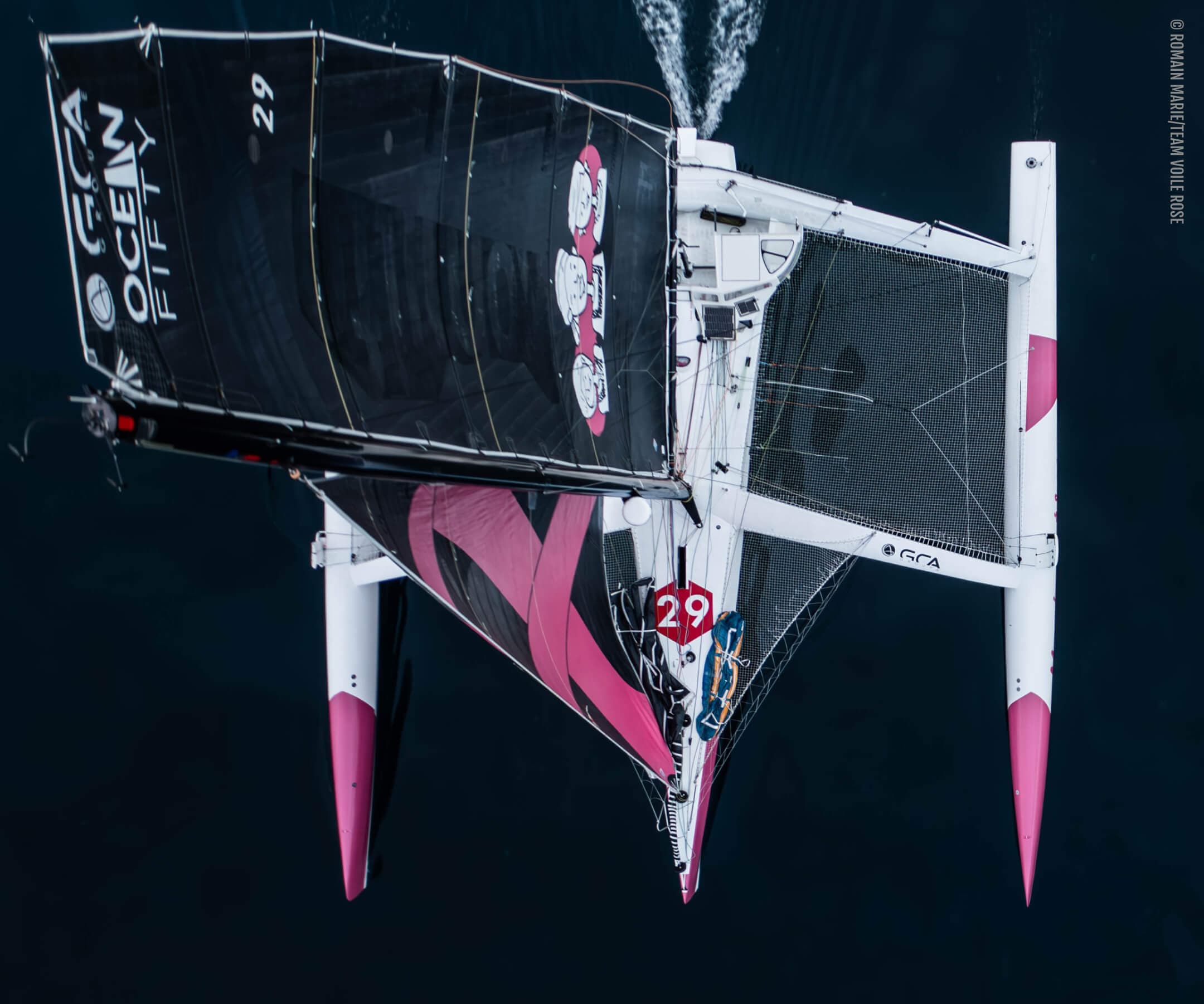
Eight metres ten of carbon, three strapped-in crew, and take-off at 8 knots of wind. From 1 to 4 July 2026, the ETF26s reclaim Lake Garda for the 12th edition of Foiling Week. Four days of aerial sprints at the foot of the Alps, where the Ora thermal wind transforms every afternoon into a motorway for flying catamarans.
For the ETF26 class, this Italian stopover is far more than a summer gathering. Positioned just after the Campione del Garda Grand Prix and before the French rounds at Lorient and Quiberon, Foiling Week serves as a defining moment in the European calendar. On this body of water where the slightest steering error costs seconds—and sometimes breakages—consistency matters as much as outright speed.
From Tinkerers' Gathering to Global Event
Foiling Week began as an open-air laboratory. Moth enthusiasts, a few unclassifiable prototypes, and the slightly crazy idea that foiling could break out of the initiated circle.
Twelve editions later, the laboratory has become an institution. The 2026 programme bears witness: Moth, Waszp, Switch, Birdyfish and ETF26 coexist over the same window—28 June to 5 July—offering a complete panorama of everything that flies on water, from single-handed boards to crewed multihulls.
The anchoring in Malcesine is no accident. Collaboration with Fraglia Vela Malcesine and local authorities has transformed the week into an economic driver for the entire region. Spectators, competitors, technical teams: the race village spills over onto the terraces and hotels of the small Venetian town.
The Race Course: Reliable Thermal, Maximum Demands
Lake Garda is an almost too-perfect natural stadium. Every afternoon, the Ora settles in from the south with metronomic regularity, offering ideal pressure to keep the ETF26s in constant flight.
But consistent wind doesn't mean easy sailing. The courses—typically banana-shaped upwind/downwind or short coastal formats—are optimised for foiling, with approach speeds exceeding 25 to 30 knots. At this pace, managing course boundaries and crossings with other competitors demands split-second reactions. Add potential cohabitation with other classes on the same water, and you have a high-heart-rate navigation exercise.
ETF26: The Machine Dissected
Designed by architect Guillaume Verdier and sailor Jean-Pierre Dick, the ETF26 embodies a rare compromise: pure performance in a logistically accessible format.
Key Numbers
- Length: 8.10 m—compact enough for agility, long enough for power
- Beam: 4.30 m—the lever arm needed for righting moment
- Weight: 350 kg—the lightness that permits take-off from 8 knots
- Top speed: over 30 knots—average speed often exceeds 2.5 times wind speed
- Crew: 3 to 4 people—coordination essential for every manoeuvre
- Upwind sail area: 29.5 m² mainsail + 11 m² jib
An Assisted One-Design for Sporting Equity
The strict One Design format is the crux of the matter. To prevent material disparities from skewing results, Anemo Sailing provides centralised technical support. A technician is present on the water with spare parts stock, enabling repairs between races. Coaches also support novice teams in mastering the machine. The message is clear: here, it's the sailing that makes the difference, not the budget.
The ETF26 also advances the "Trailer Foiler" concept—a foiler transportable on a trailer, rigable without a crane. An ecological and economic argument that makes perfect sense when compared with the logistics of large ocean multihulls.
The Forces at Play
The 2026 edition confirms the growing appeal of the series with a strong international field.
- Team Fin1 Racing: the Finnish team led by Allan Norregaard remains the circuit's technical benchmark. Their track record on platforms as varied as the 49er, Nacra 17 and F50 gives them formidable adaptability, especially in the variable morning conditions on Lake Garda.
- The European fleet: France, Italy, Denmark, United Kingdom—the circuit mixes professional sailors from Olympic backgrounds with enlightened amateurs seeking thrills. This diversity defines the class's DNA.
Find the entered boats and compare their characteristics on spencer.club.
Strategic Stakes for July
The Race Within the Race: The 2026 Calendar
Five major events punctuate the ETF26 season: Mar Menor, Campione del Garda, Foiling Week, Lorient, Quiberon. Managing fatigue, logistics and equipment across this tight sequence will be decisive for the overall standings. Foiling Week, in the heart of summer, arrives when gaps widen—or close.
Standing Out in the Crowd
With five flying classes in the same week, the battle for visibility is real. The ETF26 has a spectacular advantage: few things capture the public eye like an 8-metre catamaran launched at over 30 knots, hull entirely clear of the water. But the race slots and media coverage must follow.
Regulations and Safety
The evolution of foiling-specific racing rules continues to weigh on strategies. Starts, crossings, priorities: at these speeds, the slightest regulatory ambiguity can cost a penalty—or worse. Race committees closely monitor the application of these still-young rules, refined edition after edition.
Follow Foiling Week news and the complete ETF26 season calendar on spencer.club.
Don't miss any major race
Receive upcoming offshore sailing milestones directly by email.
Projects available in the classes of this race
Selection based on the race class(es). Actual participation depends on official entries.
- Spencer
- Spencer
- Spencer
Would you like to contribute?
Propose an event, a podcast or an article related to offshore sailing.
Is any information missing or incorrect? Let us know.
Propose a contributionDon't miss any major race
Receive upcoming offshore sailing milestones directly by email.