Dates
February 1, 2028 → March 31, 2028
Route
Brest
View table of contents
On February 1, 2028, the roadstead of Brest will release into the winter Atlantic the fastest machines ever built for a round-the-world race. Giant 32-meter trimarans capable of flirting with 50 knots, crews reduced to a single man or woman, 21,600 nautical miles non-stop: the Brest Atlantiques returns with tenfold ambition.
A legacy forged in 2024
The history of this Brest-to-Brest challenge is still young, but it has already produced its founding images. On January 7, 2024, six solo sailors set off for the first round-the-world race in Ultims. Charles Caudrelier, at the helm of Maxi Edmond de Rothschild, closed the loop in 50 days, proving it was possible to fly a giant trimaran around the planet without destroying it.
The gamble was far from a foregone conclusion. Technical stops, retirements, foil damage: the inaugural edition was a reminder that these machines remain prototypes pushed to the extreme. Four years later, the teams return with a new certainty—they now know exactly what the sea demands of them.
Three capes, 40,000 kilometers, zero safety net
The course doesn't change. And that's just as well: there is no more selective route.
- Cape of Good Hope — the pivot into the Indian Ocean and its confused seas
- Cape Leeuwin — the midpoint, swept by violent low-pressure systems
- Cape Horn — katabatic winds, drifting icebergs, then the long climb back up the Atlantic
The February 1 start (slightly shifted from 2024) aims to exploit winter depressions to propel the fleet south at high speed. The flip side: the first days will be the most exposed. Finishes are expected before March 31, at the start of Breton spring.
Solo, unassisted—but not without a safety valve
The DNA of the race remains uncompromising: solo, non-stop, unassisted. One sailor, one boat, the entire planet to wrap up.
The rules do, however, allow technical pit stops—a vital safety valve for such complex machines. But the price to pay is enormous. In 2024, Armel Le Cléac'h watched his ambitions collapse after two forced stops on Banque Populaire XI. The lesson is crystal clear: victory is prepared as much in the design offices as in the Southern Ocean depressions.
Two classes, two stories
For the first time, the giant Ultims will share the billing with the Ocean Fifty. Two fleets, two philosophies, two races within the race.
Ultim 32/23—absolute speed
32 meters long, 23 meters wide, foils capable of lifting the entire boat above the water: Ultims are the Formula 1s of the oceans. Top speed approaching 50 knots, round-the-world target in under two months. Each boat is a unique prototype, the result of millions of euros in investment.
Ocean Fifty—close-quarters racing
More compact (15 meters), subject to strict rating rules that guarantee fairness, the Ocean Fifty exceed 30 knots and offer what the Ultims cannot: finishing gaps that could be measured in minutes rather than days. The spectacle will be different, but just as intense.
| Feature | Ultim 32/23 | Ocean Fifty |
|---|---|---|
| Length | 32 m | 15 m |
| Beam | 23 m | 15 m (max) |
| Max speed | ~50 knots | >30 knots |
| Philosophy | Open innovation, full foiling | One-design, controlled budgets |
| Challenge | Record, technological endurance | Close combat, strategy |
The men to beat
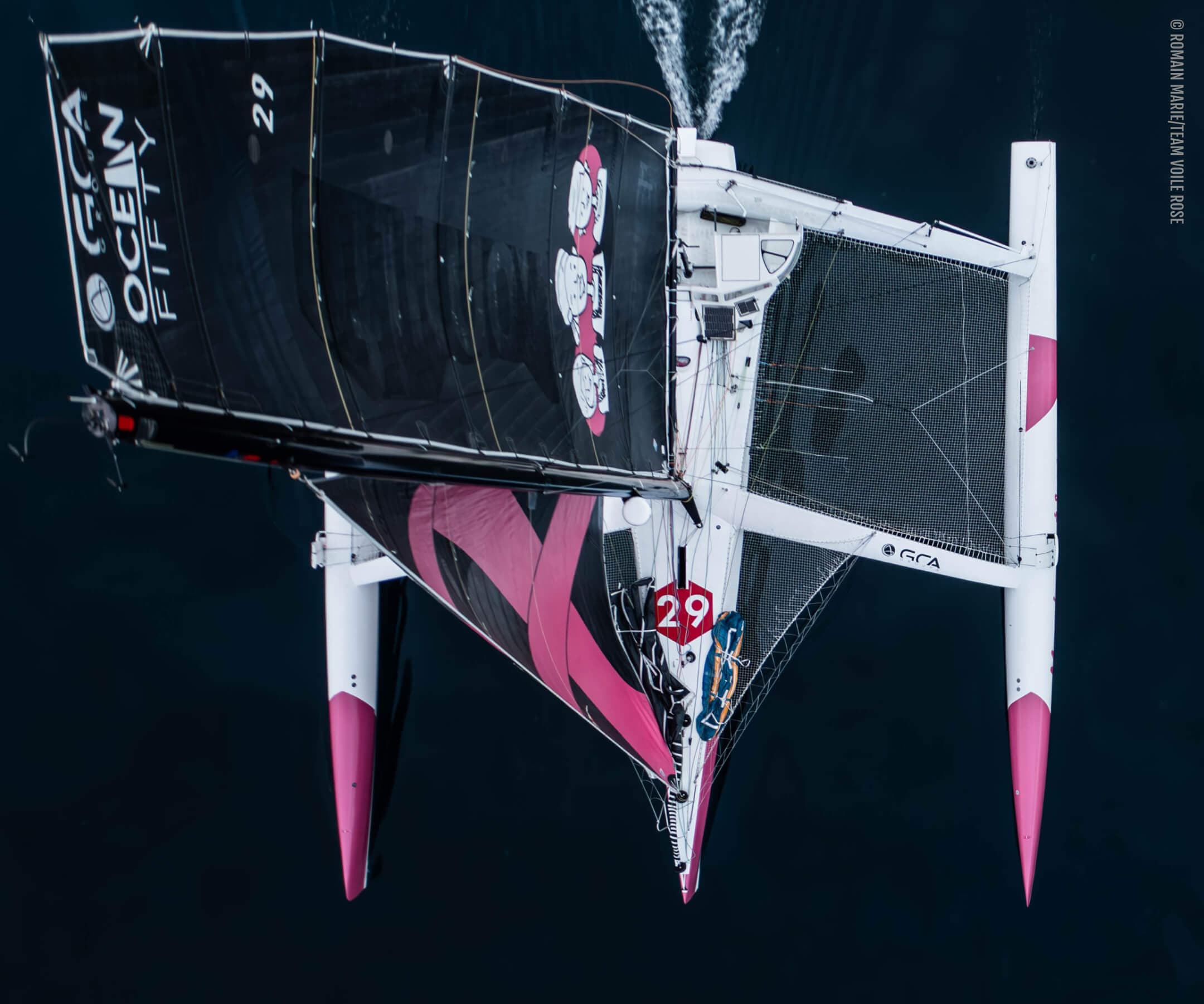
In Ultim
- Charles Caudrelier (Maxi Edmond de Rothschild)—defending champion, race record holder. His trimaran, launched in 2017, remains a benchmark for reliability. The stated goal: drop below 50 days.
- Thomas Coville (Sodebo Ultim 3)—finished just three days behind Caudrelier in 2024. The man's massive experience (multiple round-the-world races) makes him public enemy number one.
- Armel Le Cléac'h (Banque Populaire XI)—winner of the 2016-2017 Vendée Globe, he returns with a thirst for revenge after the breakdowns that torpedoed his first attempt.
- Tom Laperche (SVR Lazartigue)—one of the most technologically advanced trimarans in the fleet, an outsider to watch very closely.
In Ocean Fifty
- Erwan Le Roux (Koesio)—often cited as favorite, highly optimized machine
- Luke Berry (Le Rire Médecin–Lamotte)—class winner at the 2023 Fastnet
- Matthieu Perraut (Inter Invest)—taking over the former Primonial, he inherits an already performing project
Find the complete entry list and compare boats on spencer.club.
The real stakes extend beyond the finish line
For the Ultim class, 2028 must confirm that the 2024 feat wasn't a one-off. The prowess must become the norm. Prove that these trimarans can fly far and long without breaking—edition after edition.
For the Ocean Fifty, the challenge is visibility. Sharing the billing with the Ultims on such a prestigious course is an opportunity to demonstrate that the spectacle isn't reserved for eight-figure budgets.
Economically, the event confirms Brest and Brittany in their status as the world capital of offshore racing. Media impact, spectacular images captured by drones and onboard cameras: the sponsors injecting millions into these programs expect a return to match.
February in the North Atlantic: calculated risk
The main adversary doesn't wear a sail number. A mid-winter start exposes the fleet to storms from the very first hours. In 2024, technical stops reshuffled the entire hierarchy. In 2028, the teams' ability to manage logistical crises—shipping spare parts, mobile repair teams positioned around the globe—will weigh as much as the skipper's talent.
The density of the calendar leading up (Rolex Fastnet, Ultim circuit) leaves little margin for preparation. Every mile sailed before the start is both training and potential wear.
A cycle taking shape
The Brest Atlantiques is part of a long-term program unveiled by the Ultim Class: a solo round-the-world race every four years, modeled on the Vendée Globe. The opening to the Mediterranean and the diversification of intermediate courses show a desire to expand the playing field and the audience for these flying machines.
On February 1, 2028, when the mooring lines are cast off in the Brest roadstead, six or seven giant trimarans and a flotilla of Ocean Fifty will head for the deep South. Two months of suspense between the confines of the Southern Ocean and the Brest channel. Follow the entire race and the departure schedule on spencer.club.
Don't miss any major race
Receive upcoming offshore sailing milestones directly by email.
Projects available in the classes of this race
Selection based on the race class(es). Actual participation depends on official entries.
- Spencer
- Spencer
- Spencer
Would you like to contribute?
Propose an event, a podcast or an article related to offshore sailing.
Is any information missing or incorrect? Let us know.
Propose a contributionDon't miss any major race
Receive upcoming offshore sailing milestones directly by email.